Showing posts with label learn arabic. Show all posts

Monday, January 30, 2017

Arabic Particles: Learn Arabic Preposition لِ li

Learn Arabic Preposition لِ li meaning shades and usage.

Learn Arabic Preposition Li

See Arabic Particles Meanings series to learn Arabic particles and related words meanings.
Also see Arabic Particles Quick Study Tool.

Last edited on : 30 January 2017
Click below box to toggle between post's dark, light and white modes.
         
All the credit and all the praises and all the thanks for whatever is good and beneficial in this post and all the other posts, tools, and projects are just for ALLAH, and whatever shortcoming or mistake there is in any of these is due to me, an ordinary slave of ALLAH! and I seek ALLAH's forgiveness and pardon for any shortcomings and mistakes in any of these. 

1 (n) . The core meaning shade of Arabic preposition لِ li appears to be
to point out or specify the one to whom something is
owned by, belonging to, possessed by,
due to or for, owed to, right of, permitted for,
peculiar or specific to, 
for utilization or benefit or service of, for the advantage of,
possessed by,
related to,
etc.
or to point out the
reason, cause, purpose, outcome, result etc.
or to point out the thing or being in reference to whom
some act is done or something is said
for , to , of / regarding, by etc.
or we may also say
to specify its genitive mentioned after it with the relation to which what is mentioned before it is related to, e.g. to specify the possessor and relate it to the thing possessed by it, or to specify the owner and relate it to what is owned by it etc.

[ for , exclusively for , to , belongs to , of , by ]
Notes: Usage in the shade of by is usually derived from belonging to, an act or saying belonging to someone can also be referred to as by. Similarly, the of is usually the one used in book of Asim etc. 

2 (h,w,n) . The lam ل when used as preposition or genitive particle is written with kasrah i.e. as لِ li except in following cases where it is written with fathah i.e. as لَ la
i. With attached pronouns it is written لَ la except with with 1st person singular ى which it is written لِ li
لِى لَنَا لَكَ لَكِ لَكُمَا لَكُمْ لَكُنَّ لَهُ لَهَا لَهُمَا لَهُمْ لَهُنَّ
ii. With the person or group called to help using يَا and if there is more than 1 person or group called to help using a single يَا then only the 1st is written لَ la and remaining written لِ li.
يَا لَزَيْدٍ وَلِعَاصِمٍ O for Zaid and for Asim!
iii. With the wondered at using يَا e.g
يَا لَلْعَجَبِ O to / for the wonder!
In this post, the lam ل when used as a preposition, is referred to as the Arabic preposition لِ li, since except the above exceptions it is always written as لِ li.

3 (h,w,n) . The Arabic preposition لِ li is used to indicate
one or multiple of the following meaning shades
ownership,
making owner,
quasi-ownership,
making quasi-owner,
right or permission
deserving,
peculiarity / specific to,
utilization / benefit / service,
relation etc.
Usually books separate the shades like the above, as separate points but usually an overlap exists and more than 1 shade is applicable, so I have mentioned these together as 1 point, and explained some of these points separately also.  

[ for , exclusively for , to , belongs to ]

اَلْحَمْدُ لِلّٰهِ All the thankful praises are exclusively for ALLAH. (Translation attempt for words from The Qur'an 1:2)
وَلِلّٰهِ مَا فِى ٱلسَّمَاوَاتِ وَمَا فِى ٱلْأَرْضِ and belongs to ALLAH what is in the heavens and what is in the earth. And is exclusively for ALLAH what is in the heavens and what is in the earth. (Translation attempt for words from The Qur'an 3:109)
وَهَبْتُ لِزَيْدٍ دِينَارًا I gave to Zaid a Dinar.
فَلَهُ ذٰلِكَ then for / to him is that. (i.e. he has a right or permission to / for that)

4 (w,n) . The Arabic preposition لِ li is used along with its noun or pronoun, to indicate
has, have, had, which literally can be translated as for so and so.

[ for , { has , have, had } (note: this is not the translation of لِ li alone and includes the meaning from the noun or pronoun also) ]

كَانَ لِلْمَلِكِ مِائَتَا عَبْدٍ there were for the king 200 slaves. The king had 200 slaves. 

5 (w,h) . The Arabic preposition لِ li is also used to indicate
the author of a book, poem, saying, work etc.

[ belongs to , of , by ]

هٰذَا ٱلْكِتَابُ لِعَاصِمٍ this book belongs to / of / by Asim.
كَمَا قِيلَ لِعَاصِمٍ like what was said by Asim. 

6 (w) . The Arabic preposition لِ li is also used to indicate
right or permission

[ for , to ]

فَلَهُ ذٰلِكَ then for / to him is that.  (i.e. he has a right or permission to / for that)

7 (w) . The Arabic preposition لِ li is also used to indicate
advantage or benefit etc as opposed to عَلَىٰ indicating harm. 

[ for , to ]

مَا لَهَا وَمَا عَلَيْهَا what is for it and what is upon / against it. 

8 (w) . The Arabic preposition لِ li is also used to indicate
creditor as opposed to عَلَىٰ indicating the debtor. 

[ for , to ]

لِى عَلَيْكَ أَلْفُ دِرْهَمٍ for / to me upon you are a 1000 dirhams. You owe me a 1000 dirhams.

9 (w) . The Arabic preposition لِ li is also used
with the pronominal suffix instead of using the noun or pronoun with the pronominal suffix directly. 

[ to , for , of ]

جَاۤءَ لِى أَخٌ a brother to / for me came or a brother of mine came, instead of جَاۤءَ أَخِى my brother came. The 1st method avoids making the noun definite implying a brother, while in 2nd method the noun is made definite, implying a specific brother in context.

10 (h,a) . The Arabic preposition لِ li is also used with the verb قَالَ and some related verbs to
deliver or communicate what is said to the one to whom something is said.

[ to , for ]

قَالَ لَكَ he said to you. He said for you (i.e. his saying was targeted for your listening).

11 (w) . The Arabic preposition لِ li is also used with the verb قَالَ to indicate
that in reference to or regarding which something is said.

[ of ] (regarding)

قَالَ لَكَ he said of you (i.e. his saying was regarding/about you).
يُقَالُ لَهُ حَنِيفٌ it is said of him Haneef . He is called Haneef. 

12 (w,n) . The Arabic preposition لِ li is also used to indicate
desire or wish or inclination or intent, and usually in such cases it is used with أَنْ and another preposition.

[ for , to , have , {overall translation for the statement with لِ and أَنْ and another preposition} ]

فَقُلْ هَل لَّكَ إِلَىٰۤ أَنْ تَزَكَّىٰ then say, is there for / to you inclination that you attain tazkiyah? (form V) (attain growth step by step towards your true potential by purifying yourself from the impurities and hurdles). Then say, do you have inclination that you attain tazkiyah? (attain growth step by step towards your true potential by purifying yourself from the impurities and hurdles) (Translation attempts for The Qur'an 79:18)
هَل لَّكَ فِى أَنْ تَفْعَلُ هٰذَا do you intend to do this? Is there for / to you in case that you do this? Is there for / to you in doing this?

13 (w) . The Arabic preposition لِ li is also used to indicate
the purpose, reason or cause
to achieve which anything is done or something is.

[ to , for ]

قَامَ لِنُصْرَتِهِ he stood up to aid him. He stood up for aiding him. 

14 (w,n) . The Arabic preposition لِ li is also used to indicate
the purpose, reason or cause
because of which anything is done or something is.

[ due to ] ( because of )

وَلِهٰذَا قِيلَ and due to this it was said.

15 (w,n) . The Arabic preposition لِ li is also used to indicate
the reason or cause
and is used together with مَا and the pronoun or noun to indicate
what is the reason for you, what has happened to you etc.

[ to , for , reason for , happened to ]

مَا لَكَ لَا تَفْعَلُ هَٰذَا what has happened to you, you don't do this. What is the reason for you, you don't do this.

16 (p,n) . The Arabic preposition لِ li is also used
with the imperfect مُضَارِع verb made مَنْصُوب accusative, due to mentioned or (not mentioned) implied أَنْ or mentioned كَيْ to indicate
the purpose, reason or cause
to achieve which the action is done

[ for , to , so (this translation of so is used when it is used with أَنْ or كَيْ and then لِ and one of these can be translated together as so that and sometimes أَنْ is implied but not mentioned ]

Another thing to keep in mind for this point and below mentioned 2 more points, is that, it is possible to translate أَنْ and مُضَارِع verb together in the sense of verbal noun.

وَأُمِرْتُ لِأَنْ أَكُونَ أَوَّلَ الْمُسْلِمِينَ and I was commanded so that I be the 1st of the Muslims. And I was commanded for being the 1st of the Muslims. And I was commanded to be the 1st of the Muslims. (Translation attempts for The Qur'an 39:12) 

17 (p,n) . The Arabic preposition لِ li is also used
with the imperfect مُضَارِع verb made مَنْصُوب accusative, due to mentioned or implied أَنْ to indicate
the effect of the action (not the intent for the action), or
the eventual outcome, end result, ultimate state or condition

[ for , to , so (this translation of so is used when it is used with أَنْ or كَيْ and then لِ and one of these can be translated together as so that and sometimes أَنْ is implied but not mentioned ]

فَٱلْتَقَطَهُ ۥۤ ءَالُ فِرْعَوْنَ لِيَكُونَ لَهُمْ عَدُوًّا وَحَزَنًا then picked him adherents of fir'aun so that he becomes for them an enemy and a grief. Then picked him adherents of fir'aun for becoming for them an enemy and a grief. Then picked him adherents of fir'aun to become for them an enemy and a grief. (Translation attempts for words from The Qur'an 28:8)

18 (p,a,h,n) . The Arabic preposition لِ li is also used
with the imperfect مُضَارِع verb made مَنْصُوب accusative, due to mentioned or implied أَنْ in addition to having مَا كَانَ or لَمْ يَكُنْ at the beginning, to indicate
corroboration of negation

[ for , to , such (this translation of such is used when it is used with أَنْ that and having مَا كَانَ or لَمْ يَكُنْ at the beginning then لِ and one of these can be translated together as such that and sometimes أَنْ is implied but not mentioned ]

وَمَا كَانَ ٱلْمُؤْمِنُونَ لِيَنْفِرُوا كَاۤفَّةً  nor are the believers such that they go out as an all-inclusive whole. Nor is it for the believers that they go out as an all-inclusive whole. Nor are the believers to go out as an all-inclusive whole. (Translation attempts for words from The Qur'an 9:122)

19 (n,a) . The Arabic preposition لِ li is also used with ءَامَنَ also written as اۤمَنَ and related verbs to indicate
believing someone.

[ of , by , his (for لِ and pronoun together ) , to , for , (in English usage and style, believe alone usually conveys this sense) ]

اۤمَنَ لَهُ he believed his (saying/promise etc.) or he believed (saying/promise etc.) of / by him or he believed to / for him or he believed him. (i.e. believed something of his e.g. his saying, his promise etc.)
vs
اۤمَنَ بِهِ he believed in him. (i.e. believed in connection with his being or existence)

20 (n) . The Arabic preposition لِ li is also used
in cases like falling to, going down to or in cases like of or by some part of body, e.g. side of forehead, side etc.
In English, there are 2 ways of saying the following statement: to your knees vs on your knees, and like in English, you won't say when someone mentions to your knees that he actually meant on your knees. Similarly, in English fell on the ground and fell to the ground are not the same and we can't say when someone says fell to the ground, that no, you meant fell on the ground. Similarly in Arabic, we can't say for someone who says لِ that no, he actually meant to say عَلَىٰ here.

[ to , for , by ]

وَتَلَّهُ لِلْجَبِينِ and he laid him down to / by the forehead's side. (Translation attempt for words from The Qur'an 37:103)
يَخِرُّونَ لِلْأَذْقَانِ سُجَّدًا they fall down to the chins in prostration. (Translation attempt for words from The Qur'an 17:107)
وَإِذَا مَسَّ ٱلْإِِنْسَانَ ٱلْضُّرُّ دَعَانَا لِجَنۢبِهِ أَوْ قَاعِدًا أَوْ قَائِمًا and when touches the human the harm, he calls Us to / by his side or sitting or standing (Translation attempt for words from The Qur'an 10:12)

21 (n,w,f) . The Arabic preposition لِ li is also used to indicate
time or time period or range/duration of time.

[ for , to , by ] (when , at (i.e in specifying or pointing to time or duration, at or when may also be used))

لِأَجَلٍ مُّسَمًّى for a specified duration. (Focus on the duration from the start till the end).
vs
إِلَىٰ أَجَلٍ مُّسَمًّى till a specified duration. (Focus on the ending of the duration)
Both these may be referring to the same duration, but the way of saying it highlights 2 different angles of looking at this duration.

أَقِمِ ٱلصَّلَاةَ لِدُلُوكِ ٱلشَّمْسِ إِلَىٰ غَسَقِ ٱللَّيْلِ وَقُرْآنَ ٱلْفَجْرِ ۖ إِنَّ قُرْآنَ ٱلْفَجْرِ كَانَ مَشْهُودًا
establish the Salaat for / by / at the declining of the sun till the darkening of the night and the recitation of the dawn, indeed the recitation of the dawn is witnessed. (Translation attempt for The Qur'an 17:78) (The لِ appears to be pointing out the duration indicated in "the declining of the sun till the darkening of the night" i.e. during this time 4 obligatory Salaat are established. The Salaat of Dawn is referred to separately as recitation of the dawn i.e. recitation of The Qur'an in The Fajr Salaat.)

لِلَيْلَةٍ مَضَتْ مِنَ ٱلشَّهْرِ when a night passed from the month.

لِوَقْتِهِ at its time.

22 (w) . The Arabic preposition لِ li is also used
with the person or group called to help using يَا and if there is more than 1 person or group called to help using a single يَا then only the 1st is written لَ la and remaining written لِ li. Similarly لِ li is also used with the person or group against whom the help is called for.

[ to , for ]

يَا لَزَيْدٍ وَلِعَاصِمٍ O for Zaid and for Asim! (i.e. call for help Zaid and Asim)
يَا لَزَيْدٍ لِعَاصِمٍ O for Zaid to Asim! (i.e. call for help, Zaid to defend against Asim)

23 (w) . The Arabic preposition لِ li is also used
for calling someone using يَا to something, with both of which ل is used, in a similar way as in above point.

[ for , to ]

يَا لَلرِّجَالِ لِلْمَاۤءِ O for the men to the water! (i.e. call for the men, to access the water)

24 (w) . The Arabic preposition لِ li is also used
with the wondered at or surprised at using يَا e.g.

[ to , for ]

يَا لَلْعَجَبِ O to / for the wonder!

In cases like above 3, the لِ seems to point out the person or thing, in reference to which the exclamation is said, as being the origin or cause of it. 

25 (n) . Lets recap some uses of لِ again using a simple example 
لَهُ exclusively for him / for him / to him / belonging to him / his / of him / by him . 

26 . To study this particle further in many other books read the pages for this particle in
Arabic Particles Tool . Also to see other posts in Arabic Particles Meanings series.

References: When multiple references mentioned for a point, it means material selected from all quoted references more from some and less from others and all quoted references do not necessarily agree on everything. Material is not exactly copied but based on the reference quoted and I have made additions, editions & changes where required :
w = Wright Arabic Grammar English
h = Howell Arabic Grammar English
l = Lane's Lexicon
n = New indication by me
a = Arabic Almanac and Mawrid Reader books
p = Arabic Particles Tool books
m = Sharh of Miatu Amil .
f =  Fischer Arabic Grammar (its PDF can be downloaded from the link).

Arabic has been typed using the free and detailed Arabic keyboard, latest live version of which is available at:
Online Arabic Keyboard to Type Arabic Directly using English Keyboard with 7 Arabic Web Fonts .


Funding is required to continue Arabic Particles and related words research. Stage 2 posts are also ready for the following:
بَلۡ بَلَىٰ كَ إِنۡ أَنۡ سَ سَوۡفَ أَ هَلۡ إِذۡ إِذَا إِذًا أَنَّىٰ لَـٰكِنۡ لَـٰكِنَّ

Saturday, December 24, 2016

Arabic Particles: Learn Arabic Preposition بِ bi

Learn Arabic Preposition بِ bi meaning shades and usage.
Learn Arabic Preposition bi
See Arabic Particles Meanings series to learn Arabic particles and related words meanings.
Also see Arabic Particles Quick Study Tool.

Last edited on : 4 January 2017
Click below box to toggle between post's dark, light and white modes.
         

1 (n,k) . The core meaning shade of Arabic preposition بِ bi appears to be
connection.
which is, on a deeper analysis, visible or traceable in almost all its meaning shades. 

2 (n,l,h,m) . The Arabic preposition بِ bi is used to indicate
connection, adhesion, adjunction, association.

The usage of بِ bi can either be
real / proper / physical / perceptible by sense (e.g. physically connected with something)
tropical / ideal / conceptual / perceptible by intellect (e.g. conceptually connected like he did this in connection with that plan )

The usage of بِ bi can either be
Absolute e.g. he came with him.
Relative e.g. he passed by him (i.e. without physical contact but just relative to him, which we can also say in connection with or with reference to).

[ with , in , by, connected with , adhered to , in connection with , with reference to ]

بِهِ دَاۤءٍ with / in / connected with / adhering to him is a disease.
مَرَّ بِهِمْ he passed by / in connection with / with reference to them.
جَلَسَ بِهِ he sat with / by him.

3 (l,h,f) . The Arabic preposition بِ bi is also used to indicate
instrument or tool, using a thing as an aid or instrument. 

[ with , by means of ]

كَتَبَ بِٱلْقَلَمِ he wrote with the pen.
ضَرَبْتُ بِٱلسَّيْفِ I struck with the sword.

4 (l,h) . The Arabic preposition بِ bi is also used to indicate
accompaniment / concomitance.

[ with ]

اَلْفَرَسُ بِلِجَامِهِ وَ سَرْجِهِ the horse with its bridle and its saddle.

5 (p) . The Arabic preposition بِ bi is also used to indicate
accompanying state or accompanying environment.

[ with , with a state of , in a state of ]

هَبَطَ بِسَلَامٍ he descended with / with a state of / in a state of safety.

6 (l,h)(n) . The Arabic preposition بِ bi is also used to indicate
connection with a place, time or event ( place + time + happenings )

[ with , in , in connection with ]

وَلَقَدْ نَصَرَكُمُ اللّٰهُ بِبَدْرٍ and assuredly ALLAH already Helped you(pl) with Badr. (Translation attempt for words from The Qur'an 3:123)
This help was in connection with the event of Badr.
An event includes the place, the time, and other things that happen during it.
Note: In English also, it is said, he helped you with your project, he helped you with your assignment, he helped you with your homework.

جَلَسَ بِٱلْمَسْجِدِ he sat in the masjid. He sat connected with (a location inside) the masjid.
جَلَسَ فِى ٱلْمَسْجِدِ he sat in the masjid. He sat within the masjid (inside the boundary of the masjid).
In both these cases, he is in the masjid, but there is a subtle difference in terms of the angle with which we are looking at this situation or the angle we want to highlight while describing the fact that he is in the masjid.

7 (l,h,p,n) . The Arabic preposition بِ bi is also used to indicate
reason, in connection with which something is done. (Reason, because of which something is done) 

[ by , with ,  in connection with , because of ]

إِِنَّكُمْ ظَلَمْتُمْ أَنفُسَكُمْ بِٱتِّخَاذِكُمُ ٱلْعِجْلَ certainly you(pl) have wronged your(pl) selves by / with / in connection with / because of your(pl) adopting the calf. (Translation attempt for words from The Qur'an 2:54) 

8 (l,h,n) . The Arabic preposition بِ bi is also used to indicate
the giving or doing of something as a substitute / replacement / payment
with which something else is obtained. 
The giving of or doing of something in return for getting something else. 

[ with ] ( in exchange for , in replacement for )

هٰذَا بِذٰلِكَ this in replacement for that.
اِشْتَرَيْتُهُ بِأَلْفِ دِرْهَمٍ I acquired it with a 1000 dirhams.

9 (l,h,a,n) . The Arabic preposition بِ bi is also used to
render a verb transitive and is also used with some verbs to make idioms.

[ with , (modification of verb meaning e.g. come becomes bring, go away becomes take away) ]

ذَهَبَ he went away. (Form I)

أَذْهَبَهُ he caused him to go away. (Form IV. Impact of this case is that he caused his going away or initiated it.)

ذَهَبَ بِهِ he went away with him. (Form I with separable role of بِ and verb. Impact of this case is that he performed the act of going away with him or with his accompaniment.)

ذَهَبَ بِهِ he took him away. (Form I with combined role of بِ and verb. Impact of this case can be that he had an active role in taking him away but he did not himself go away with him, or it can be that he took him away holding him.)

ذَهَبَ بِهِ he did away with him (i.e. finished him). (Form I and بِ in the sense of idiom)
(Note: Do away with is also used as an idiom in English in the same sense)

10 (n) . The Arabic preposition بِ bi is also used to indicate
in connection with or with reference to something.

[ in connection with , with reference to ]

سَأَلَ بِهِ he asked in connection with / with reference to it.
vs
سَأَلَ عَنْهُ he asked of / regarding / about it.

11 (a,n) . The Arabic preposition بِ bi is also used to indicate
the target or recipient.

[ with ]

أَحْسَنَ بِكَ he was well with you.
vs
أَحْسَنَ إِلَيْكَ he was well towards you.

12 (h,l,s,n,m) . The بِ bi is also used as
the original particle of swearing 
The بِ bi is attached before (i.e. prefixed) to what / who is sworn by or promised by or to what / who is taken as witness / sign / evidence.  With بِ or by means of بِ we attach the swearing to the sworn by or we simply attach the بِ to the sworn by. In English also the word by plays a similar role.

Since بِ is the original particle of swearing, it has some unique features among particles of swearing :
i. The بِ bi can be prefixed to the pronoun also.
ii. The verbs of swearing e.g حَلَفَ or أَقْسَمَ etc. can be mentioned with بِ bi, instead of suppressing them.
iii. The بِ bi can be used for (conciliatary and propitiatory) adjuring or conjuring (of the one addressed) for inducing him to incline to that which is desired of him e.g. (I adjure you) by...

[ by ]

بِاللّٰهِ لَاَفْعَلَنَّ كَذَاۤ إِنْ شَاۤءَ اللّٰهُ by ALLAH, I will certainly do like this, inshaALLAH!

13 (w) . The Arabic preposition بِ bi is also used with
غَيْر and لَا to indicate without
بِغَيْرِ with other than , without
بِلَا with no, without

14 (n) . The Arabic preposition بِ bi is also used to indicate
connection between 2 statements or between a word and a statement or connection between 2 words.
Many examples from this category are usually called corroborative or redundant بِ but a closer and deeper examination indicates that the overall meaning shade with and without it is different.

Related concepts to this point are :
i. A word on a verb form I active participle pattern or verb form I passive participle pattern is also sometimes used as a verbal noun.
ii. A word or statement coming after بِ bi can also be denoting a state.
iii. When a statement is connected with some one, it can imply is always etc. When a statement is connected in a negative sense, it can imply is never or is not at all, is in no way etc.
Someone + bi + Statement. This someone is connected with this statement. We can say the statement always holds true for him.
Negative + Someone + bi + Statement. This someone has no connection with this statement. We can say the statement never holds true for him or is in no way and not at all connected with him.

[ with , connected with , in connection with , with a state of , in a state of , (overall impact in translation of the set of words or statements connected via it) ]

كَسَرَ بِقَلْبِكَ he performed the act of breaking with your heart. Without بِ it will be, he broke your heart.

وَكَفَىٰ بِاللّٰهِ عَلِيمًا and suffices with ALLAH as Ever-Knower. (Translation attempt for selected words from The Qur'an 4:70) . Without بِ it may be translated as, and ALLAH suffices as Ever-Knower.

وَمَا رَبُّكَ بِغَافِلٍ عَمَّا يَعْمَلُونَ and your Maintaining-Lord is never unaware regarding what you(pl) are performing. And your Maintaining-Lord has no connection with being unaware regarding what you(pl) are performing. And your Maintaining-Lord is in no way / not at all unaware regarding what you(pl) are performing. (Translation attempts for selected words from The Qur'an 6:132) . Without بِ it may be translated as, and your Maintaining-Lord is not unaware regarding what you are performing.

بِأَييِّكُمُ الْمَفْتُونُ with which of you(pl) is the affliction OR with / in which of you(pl) is the state of being afflicted OR with which of you(pl) is the afflicted. (Various possible translation attempts for selected words from The Qur'an 68:6) Without بِ it may be translated as, Which of you(pl) is the afflicted.

خَرَجْتُ فَإِذَا بِٱلْأَسَدِ I went forth and all of a sudden was with the lion.

15 . To study this particle further in many other books read the pages for this particle in
Arabic Particles Tool . Also to see other posts in Arabic Particles Meanings series.

References: When multiple references mentioned for a point, it means material selected from all quoted references more from some and less from others and all quoted references do not necessarily agree on everything. Material is not exactly copied but based on the reference quoted and I have made additions, editions & changes where required :
w = Wright Arabic Grammar English
h = Howell Arabic Grammar English
l = Lane's Lexicon
n = New indication by me
a = Arabic Almanac books
p = Arabic Particles Tool books
m = Sharh of Miatu Amil .
f =  Fischer Arabic Grammar (its PDF can be downloaded from the link).
k = At Tahqeeq fi Kalimat il Qur'an il Kareem (its PDF can be downloaded from the link)
s = A Study of Qur'anic Oaths .

Arabic has been typed using the free and detailed Arabic keyboard, latest live version of which is available at:
Online Arabic Keyboard to Type Arabic Directly using English Keyboard with 7 Arabic Web Fonts .


Funding is required to continue Arabic Particles and related words research. Stage 2 posts are also ready for the following:
بَلۡ بَلَىٰ كَ إِنۡ أَنۡ سَ سَوۡفَ أَ هَلۡ إِذۡ إِذَا إِذًا أَنَّىٰ لَـٰكِنۡ لَـٰكِنَّ

Saturday, December 03, 2016

Arabic Particles: Learn Arabic Preposition عَلَىٰ ala

Learn Arabic Preposition عَلَىٰ ala meaning shades and usage.
Learn Arabic Preposition ala
See Arabic Particles Meanings series to learn Arabic particles and related words meanings.
Also see Arabic Particles Quick Study Tool.

Last edited on : 3 December 2016
Click below box to toggle between post's dark, light and white modes.
         

1 (w,h)(n) . The Arabic preposition عَلَىٰ ala is used
i. In its original local sense to indicate higher elevation or superiority of position :
a. On top of , above or over its genitive (most common) .
b. On an elevation above its genitive.
ii. To indicate outer elevation over its genitive. This elevation can be over any of the sides also, not only the top. A paint on the wall is not literally on the top of the wall but on the side face of the wall. A guard on the door is not literally sitting on top of the door but over / upon /on / at its front or entrance i.e. at an elevation not with reference to the top of the door but an elevation with reference to the front or entrance of the door. The clothes on you are not literally on top of your head, but on you with respect to being on or over your body covering over the body from. Side elevation is used in English also, e.g. in architect drawings, the views from the front and sides are called elevations. This outer elevation is indicated in books like (h,l) differently as a case of superiority of position over something near the genitive.
iii. Another related meaning is in front of which is mentioned in some books as under. This is a case of elevation from the front of its genitive.

The usage of عَلَىٰ ala can either be: 
real / proper / physical / perceptible by sense (e.g. physically on the table)
tropical / ideal / conceptual / perceptible by intellect (e.g. debt due upon someone , ruler over masses)

Genitive of عَلَىٰ ala is the word governed by it in the genitive case. 

[ on , upon , over , at , in front of ]

هُوَ عَلَى ٱلسَّطْحِ he is on / upon the flat roof.
جَلَسَ عَلَى ٱلْمَاۤءِدَةِ he sat at the table. (This can be because a person sitting at a table rises above the level of it. Also this can be because of sitting over any of its sides at an elevation with reference to its side and not with reference to its top)
عَلَيْكَ ثِيَابَ قُطُنٍ on / upon / over you are clothes of cotton. (Again this is not literally on top like cotton clothes are not above your head literally but on or upon or over your body)
قَعَدَ عَلَىٰ بَابِ دَارِهِ he sat at the door of his house.
اَلْقَرْيَةُ عَلَى ٱثْنَىْ عَشَرَ مِيلًا مِنَ ٱلْفُسْطَاطِ The town is at 12 miles from al-Fustaat. (i.e. at a side elevation or distance of 12 miles from one of its sides)
قَرَأَ عَلَىٰۤ أَبِيهِ he recited it in front of his father. 
عَلَيْهِ دَيْنٌ upon / on him is a dept.
سَلَامٌ عَلَيْكُمْ peace/safety on / upon you (all).
جَعَلَهُ أَمِيرًا عَلَى ٱلْعِرَاقِ he made him ruler over Iraq.

2 (w,n) . The Arabic preposition عَلَىٰ ala is also used to indicate
duty / responsibility / obligation / doable / dept / loan which is
due / deliverable / incumbent 
on / upon someone i.e. on the genitive of عَلَىٰ ala
Hence it is used after verbs signifying to prescribe, to decree, to make incumbent or unavoidable etc. 

[ on , upon ] ( due upon , incumbent upon )

عَلَيْهِ دَيْنٌ on / upon him is a dept OR (due) upon / on him is a dept OR (translating non-literally) he owes a dept.
عَلَيْكَ أَنْ تَفْعَلَ هَٰذَا on / upon you is that you do this OR (incumbent) on / upon you is that you do this.
(Note: In English also on is used in a similar sense, e.g., this is on you means this is your responsibility)

3 (w) . The Arabic preposition عَلَىٰ ala is also used to indicate
the advantage, superiority, or distinction, which one person or thing has over another

[ over , above ]

اِخْتَارَهُ عَلَىٰ ذَٰلِكَ he preferred it over that.

4 (w) . The Arabic preposition عَلَىٰ ala is also sometimes used
in a hostile sense, in case of which it is usually translated as upon or against. 

[ upon , against , up against , on , at ]

خَرَجَ عَلَيْهِ he went out upon / against him.
عَتَبَ عَلَيهِ he was angry on / upon / at him.
أَغْرَى ٱلْكَلْبَ عَلَيْهِ he incited the dog upon / against / at him.

5 (w) . The Arabic preposition عَلَىٰ ala is also used to indicate
the ground or basis in terms of condition/state on which a person stands with respect to religion, trade, profession, health, fortune, mental/bodily gifts etc.

[ upon , on , based upon , (standing) upon / on ]

لَيْسَ عَلَى ٱلشَّيْءِ he is not upon / on / based upon anything. He is not (standing) upon anything i.e. he has nothing to stand on.

6 (w) . The Arabic preposition عَلَىٰ ala is also used to indicate
the ground or basis in the sense of terms / condition on which something is done.

[ on , on condition ]

عَلَىٰ هَٰذَا ٱلْشَّرْطِ on this condition.
ذَٰلِكَ عَلَىٰ أَن يَّفْعَلَ that is on condition that he does 

7 (w) . The Arabic preposition عَلَىٰ ala is also used to indicate
the ground or basis in terms of the cause / reason on which one does a thing.

[ on , on account of ]

لَاۤ أَسْأَلُكُمْ عَلَيْهِ أَجْرًا I do not ask you on / on account of it a fee...  ( Translation attempt for selected words from The Qur'an 6:90 ) 

8 (w) . The Arabic preposition عَلَىٰ ala is also used to indicate
the ground or basis in terms of the means via which something is done.

[ by means of , via ]

وَعَدَكَ عَلَيْهِ he promised you by means of him. 

9 (w,n,l) . The Arabic preposition عَلَىٰ ala is also used to indicate
the rule or standard upon or based on or according to which something is done. It indicates
conformity, accordance, adaptation or agreement.

[ on , upon , based on ] ( according to )

عَلَىٰ هَٰذِهِ ٱلطَّرِيقَةِ on / upon this manner of conduct
عَلَىٰ مَا رَأَيْتُ فِى ٱلْكُتُبِ based on what I have seen in the books.

10 (w) . The Arabic preposition عَلَىٰ ala is also used to indicate
the subject on / of / concerning which we speak as if our conversation was based on it. 

[ on , of , concerning ]

قَالَ عَلَىٰ ذَٰلِكَ he spoke on that.

11 (n) . The Arabic preposition عَلَىٰ ala is also used to indicate
the being on / of / concerning whom we speak as if our conversation was based on him or our conversation was based on something under his authority or something coming from him.

[ on , of , concerning ,  concerning that which is under the authority of , concerning that which proceeds from ]

أَمْ تَقُولُونَ عَلَى اللّٰهِ مَا لَا تَعْلَمُونَ ...or do you say concerning / concerning that which is under the authority of ALLAH what you don't know. ( Translation attempt for selected words from The Qur'an 2:80 ) 

12 (w) . The Arabic preposition عَلَىٰ ala is also used to indicate
something happening in spite of / despite / notwithstanding another thing that might have prevented it.

[ in spite of , despite , notwithstanding ]

قَتَلَ أَسَدًا عَلَىٰ صِغَرِ سِنِّهِ he killed a lion notwithstanding / in spite of / despite smallness of its age. 

13 (f) . The Arabic preposition عَلَىٰ ala is also used to indicate
onto

[ onto ]

سَقَطَ عَلَى ٱلْأَرْضِ he fell onto the ground. 

14 (l) . The original letters in عَلَىٰ are ع ل و .

15 . To study this particle further in many other books read the pages for this particle in
Arabic Particles Tool . Also to see other posts in Arabic Particles Meanings series.

References: When multiple references mentioned for a point, it means material selected from all quoted references more from some and less from others and all quoted references do not necessarily agree on everything. Material is not exactly copied but based on the reference quoted and I have made additions, editions & changes where required :
w = Wright Arabic Grammar English
h = Howell Arabic Grammar English
l = Lane's Lexicon
n = New indication by me
a = Arabic Almanac books
p = Arabic Particles Tool books
m = Sharh of Miatu Amil .
f =  Fischer Arabic Grammar (this link is not a separate post on it , but its PDF can be downloaded from the page).

Arabic has been typed using the free and detailed Arabic keyboard, latest live version of which is available at:
Online Arabic Keyboard to Type Arabic Directly using English Keyboard with 7 Arabic Web Fonts .


Funding is required to continue Arabic Particles and related words research. Stage 2 posts are also ready for the following:
بَلۡ بَلَىٰ كَ إِنۡ أَنۡ سَ سَوۡفَ أَ هَلۡ إِذۡ إِذَا إِذًا أَنَّىٰ لَـٰكِنۡ لَـٰكِنَّ

Friday, November 25, 2016

Arabic Particles : Learn Arabic Preposition فِى fi

Learn Arabic Preposition فِى fi meaning shades and usage.
Learn Arabic Preposition fi
See Arabic Particles Meanings series to learn Arabic particles and related words meanings.
Also see Arabic Particles Quick Study Tool.

Last edited on : 25 November 2016
Click below box to toggle between post's dark, light and white modes.
         

1 (h) . The Arabic preposition فِى fi is used to indicate
Adverbiality
  • Real
    • Local (in place) 
    • Temporal (in time) 
  • Tropical (figurative, not literally in a place or time, but in something else, e.g. in doing something)
[ in , within , in the midst of , during ]

2 (l) . The Arabic preposition فِى fi
relates to a receptacle (container, vessel), and when used in a wider sense to that which has some near resemblance thereto and also to what is considered as a receptacle. It denotes inclusion or in-being in relation to place or time either properly or tropically.

[ in , within , in the midst of , into , during ]

3 (w) . The Arabic preposition فِى fi shows that 1 thing is actually in the midst of another, surrounded by it on all sides while the Arabic preposition بِ merely indicates that 1 is close by the other or in contact with it.

[ in , within , in the midst of ]

4 (w) . The Arabic preposition فِى fi is used to indicate
rest in a place or during a time or motion into a place
This signification is then further transferred to the relation subsisting between any 2 things, one of which is regarded as the place in which the other is, or happens or into which it goes or is put.
 
[ in , within , in the midst of , into , during ]

5 (l,w,h) . Examples for points 1 to 4 since they are conveying related and the core meaning shades of فِى fi from different angles.

[ in , within , in the midst of , into , during ]
 
فِى ٱلْبَيْتِ in / within / in the midst of the house.
فِى أَيَّامٍ مَّعْدُودَاتٍ in / during counted days.
وَقَعَ فِى ٱلْبِئْرِ he fell into the well.
وَلَكُمْ فِى ٱلْقِصَاصِ حَيَوٰةٌ and for you, in the retaliation*, is life...  ( Translation attempt for selected words from The Qur'an 2:179 )
*This is not ordinary retaliation but tit for tat style retaliation. Punishing criminal in same manner as he has punished the victim. 

6 (w, n, l) . The Arabic preposition فِى fi is also used to indicate
in the midst of , and the noun following is usually a plural or collective.
Then this primary meaning of in the midst of also gives related meaning of among or secondary meaning of with in some cases. With here does not mean close by the other or simply in contact with it, but rather with (in the midst of) or with (among) or with (in a group form) or with (join with) etc.

[ in the midst of , among , with ] (1st فِى in 1st example and the one in 2nd example)
[ in , into ] (2nd فِى in 1st example)

قَالَ ٱدْخُلُوا فِىۤ أُمَمٍ قَدْ خَلَتْ مِنْ قَبْلِكُم مِّنَ ٱلْجِنِّ وَٱلْإِنْسِ فِى ٱلنَّارِ HE Said:"You enter in the midst of / among nations which have already passed from before you of Jinn and Mankind in / into the fire..." ( Translation attempt for selected words from The Qur'an 7:38 )
تَوَجَّهَ فِى خَمْسِينَ أَلْفًا he set out in the midst of / among / with (in the form of a group) 50000.

7 (w, l) . The Arabic preposition فِى fi is also sometimes used to indicate
a combination of 2 qualities, a quality in another quality.

[ in , combined with ] (blended with, mixed with etc.)

سَوَادٌ فِى حُمْرَةٍ blackness in redness. Blackness combined with / blended with redness.
طُولٌ فِى ٱسْتِرْخَاءٍ length combined with looseness.

8 (w, l) . The Arabic preposition فِى fi is also sometimes used to indicate
multiplication (into) and proportion (in terms of length by breadth etc.)

[ into , by ]

ثَلَٰثَةٌ فِى خَمْسَةٍ three into five (in case of multiplication). Three by five (in case of length by breadth etc.)

9 (w, l) . The Arabic preposition فِى fi is also used
in the comparison of 2 objects, the one coming before فِى being inferior or smaller of the 2 and the one mentioned after فِى being superior or larger of the 2. The smaller one being, as it were, placed within the larger one for the purpose of comparing the 2.

[ in , put into , compared in , in comparison within ]

مَا ٱلْحَيَوٰةُ ٱلدُّنْيَا فِى ٱلْاۤخِرَةِ إِلَّا مَتَٰعٌ The life of the nearest (worldly life) is nothing in the last (hereafter) except consumable / temporary provision. ( Translation attempt for selected words from The Qur'an 13:26 )

10 (w) . The Arabic preposition فِى fi is also used to indicate
the subject of thought or conversation, that in which these move. Hence it is also used in stating the subject of a book or chapter.

[ concerning , regarding , about , in the matter of , in the subject / topic / case of ] ( on )

تَكَلَّمَ فِى ذَٰلِكَ he spoke concerning / regarding / about that.

11 (w) . The Arabic preposition فِى fi is also used to indicate
assigning a cause - in or for which something is done

[ in the cause of , in the interest of , for , for the sake of ]

وَٱلَّذِينَ جَاهَدُوا فِينَا لَنَهْدِيَنَّهُمْ سُبُلَنَا and those who do jihad in OUR cause , surely WE Will certainly Guide them to OUR Paths... ( Translation attempt for selected words from The Qur'an 29:69 )

12 (w) . The Arabic preposition فِى fi is also used to indicate
assigning a reason - in consequence of which something is done. 

[ in consequence of , because of ]

لَامَهُ فِى ذَٰلِكَ he blamed him in consequence of / because of that. 

13 (n) . Since Arabic preposition فِى fi is often used to indicate
in a place or in a time, sometimes on is used instead of in while translating into English since in English some phrases are usually conveyed using on but can be conveyed using in also in most cases.
For example place is paper in which the act of writing happens. He wrote in the paper or he wrote on the paper. In both these cases the paper is a place in which the act of writing happened.

[ in , on ]

كَتَبَ فِى ٱلْوَرَقَةِ he wrote in / on the paper. 

14 . To study this particle further in many other books read the pages for this particle in Arabic Particles Tool . Also to see other posts in Arabic Particles Meanings series.

References: When multiple references mentioned for a point, it means material selected from all quoted references more from some and less from others and all quoted references do not necessarily agree on everything. Material is not exactly copied but based on the reference quoted and I have made additions, editions & changes where required :
w = Wright Arabic Grammar English
h = Howell Arabic Grammar English
l = Lane's Lexicon
n = New indication by me
a = Arabic Almanac books
p = Arabic Particles Tool books
m = Sharh of Miatu Amil .

Arabic has been typed using the free and detailed Arabic keyboard, latest live version of which is available at:
Online Arabic Keyboard to Type Arabic Directly using English Keyboard with 7 Arabic Web Fonts .

Funding is required to continue Arabic Particles and related words research. Stage 2 posts are also ready for the following:
بَلۡ بَلَىٰ كَ إِنۡ أَنۡ سَ سَوۡفَ أَ هَلۡ إِذۡ إِذَا إِذًا أَنَّىٰ لَـٰكِنۡ لَـٰكِنَّ

Wednesday, November 23, 2016

Learn Arabic Word Sidq صِدْق Meaning

Learn Arabic Word Sidq صِدْق core meaning shades

Learn Arabic Word Sidq

Click below box to toggle between post's dark, light and white modes.
         

Root : ص د ق
Pattern : فِعْل
Word : صِدْق

Firm / steady / strong / robust / sound
internally, externally and in reality (e.g. when put to the test).

In accordance / fitting with truth / reality / fact and
having consistency / agreement
between inside (intention, belief) and outside (speech, actions) and reality (what is the fact of the matter or what is actually the case),
between heart and tongue and reality.

Agreement of what is said with what is conceived in the mind and also with what reality is.
Accomplishing in reality what one has said and conceived in mind.

Not only believing and saying but doing accordingly also.
Performing to potential / skill / claim .

Last edited: 23-November-2016.

Also check other posts in the Arabic Words Core Meanings Series
To study this root further, type Sdq in Arabic Roots Quick Study Tool . 

Sunday, November 20, 2016

Arabic Particles : Learn Arabic Preposition عَنْ An

Learn Arabic Preposition عَنْ An meaning shades and usage.


See Arabic Particles Meanings series to learn Arabic particles and related words meanings.
Also see Arabic Particles Quick Study Tool.

Last edited on :  5 December 2016
Click below box to toggle between post's dark, light and white modes.
         

1 (l,h,w,m) . The Arabic preposition عَنْ An is used to indicate
Passage or transition (sensibly or virtually) from the thing mentioned directly after it i.e. its genitive and distance from it. What has passed and became at a distance from its genitive.

[ from , off , away from , at a distance from ]

رَمَيْتُ عَنِ ٱلْقَوْسِ I shot off / from / away from the bow.
رَغِبَ عَنْهُ he desired to be away from it.
جَلَسَ عَنْ يَمِينِهِ he sat at a distance from his right hand.

2 (w) . The Arabic preposition عَنْ An is used to indicate
distance from, motion away from, departure from a place or from beside a person.

[ from , off , away from , at a distance from ]

Above point examples valid for this point also.

3 (w) . The Arabic preposition عَنْ An is also used for
marking the distance.

[ at a distance of ]

عَنْ خَمْسِينَ فَرْسَخًا at a distance of 50 parasangs (a measure of length).

4 (w) . The Arabic preposition عَنْ An is also used to indicate
the source from which something proceeds. Hence it shows:
i. The authority for any statement, tradition etc.
ii. The source cause from which an effect proceeds.

[ from , on the authority of , of ]

رَوَىٰ عَنْ فُلَانٍ he related from / on the authority of such a one.

5 (h,l) . The Arabic preposition عَنْ An is also used to indicate
cause

[ from , because of ]

قُلْتُ هَٰذَا عَنْ عِلْمٍ I said this from / because of knowledge.

6 (w) . The Arabic preposition عَنْ An is also used
after verbs denoting flight, avoidance, abstinence, caution, self-defense, forbidding & hindering, guarding & setting free etc.

[ from , away from ]

هَرَبَ عَنْهُ he fled from it.
وَ يَنْهَوْنَ عَنِ ٱلْمُنْكَرِ and preventing / debarring from the disapproved / unrecognized. (attempted translation of words from The Qur'an 3:104)

7 (w) . The Arabic preposition عَنْ An is also used to indicate
doing something (e.g. fighting or paying) for or on behalf of another.

[ on behalf of ] ( in place of , for ) 

يُقَاتِلُ عَنْهُ he did mortal combat on behalf of him.
حَمَلَ عَنْهُ كَذَا وَ كَذَا دِرْهَمًا he bore on behalf of / in place of / for him so and so many dirhams.

8 (w) . The Arabic preposition عَنْ An is also used
after verbs denoting informing, uncovering, removing, opening, revealing, asking & answering; for in these verbs there lies the idea of removal of a covering, real or figurative.

[ from , regarding , about ]

سَأَلَ عَنْهُ he asked regarding / about it.
كَشَفَ عَنْهُ ضُرُّهُ he removed from him his affliction.

9 (n) . The Arabic preposition عَنْ An is also used to indicate
something regarding or about its genitive.

[ regarding , about , concerning , from ]

رَضِيَ عَنْهُ he is well pleased regarding / about / from him.

10 (w) . The Arabic preposition عَنْ An is also used
after verbs denoting abandonment or neglect, and the ability to dispense with one thing because of the possession of another; because in them is implied the notion of turning away.

[ from , away from ]

صَفَحَ عَنْهُم he turned away from them
شَغَلَهُ ذَٰلِكَ عَنِ ٱلْفِكْرَةِ فِى كُلِّ شَيْءٍ إِلَّا فِيهِ that busied him away from / from the employment of thinking in everything except in it.
بَخِلَ عَنْ نَفْسِهِ he withheld from himself.

11 (w) . The Arabic preposition عَنْ An is also used
after verbs signifying to leave one behind or to surpass one.

[ from ]

فَضَلَ عَنْهُ he exceeded / surpassed from him.

12 (w,l,n) . The Arabic preposition عَنْ An is also used to indicate
after (usually relating to time) . For distance, we sometimes use at a distance of, at a distance from etc. and relating to time, we can use after a duration of . 

[ after , after a duration of ]

عَمَّا قَلِيلٍ after a little (while) OR after a duration of a little (while) OR after a little duration. 

13 (h,l,n) . The Arabic preposition عَنْ An is also used to indicate
using a thing as an aid or instrument.

[ off , from , away from ]

رَمَيْتُ عَنِ ٱلْقَوْسِ I shot off / from / away from the bow.

14 (w)(n) . To differentiate between مِنْ and عَنْ which are 2 different prepositions with related meanings, according to some
مِنْ is used for what is near while عَنْ is used for what is remote.
According to some
After the verbs for taking, borrowing etc مِنْ is used for transportable objects e.g. coins while عَنْ is used for others e.g. knowledge.
Another way to contrast the 2 is that
مِنْ is for beginning of extent (originating from etc.) while عَنْ is for transferring or passing over from (passing from, passing beyond or transferring from etc.)
Such opinions may be valid in some cases but are not proven in all examples, so can be kept in mind as an opinion, but not as a fixed rule. All the established meaning shades of both should be studied and assigned accordingly based on context and situation.

15 (w, h, l) . Note that عَنْ is also sometimes used as a noun signifying side . In such cases it is usually used along with مِنْ and in rarer cases along with عَلَىٰ

[ side ]

مِنْ عَنْ يَمِينِي  from the side of my right hand. From my right hand side .
عَلَىٰ عَنْ يَمِينِي  on the side of my right hand. On my right hand side .

16 (n) . According to some عَنْ is sometimes used in a similar meaning shade to بِ or to فِى or to عَلَىٰ or to مِنْ or to some other preposition, but a closer examination shows that still there is a difference in meaning shades, and due to context, one may assume the meaning shade is of some other particle which is more often used in such contexts, but on a closer examination, a meaning shade closer the the core meaning shades of عَنْ seems more accurate. e.g.
عَنْ vs مِنْ can be understood better after reading both prepositions in detail, since meaning shades are close. Many times from is used to translate both prepositions. But once one has the core meanings in mind, he can understand the subtle differences of using one over the other in a context.

عَنْ vs بِ can be better understood in a similar context with following example:
does not speak from whim (more focus on from where it is transferring from or caused from) vs does not speak with whim (more focus on the quality with which it is being said ) .
Another example where it is alleged that عَنْ has been used in the sense of بِ without 1st checking in detail the fact that both have been used 1 time each with حَفِيّ in The Qur'an, giving a different meaning shade to حَفِيّ when it used with each of the 2 according to almost all translators. 
حَفِيٌّ عَنْهَا used in The Qur'an 7:187 and بِي حَفِيًّا used in The Qur'an 19:47. You can see this in detail using Qur'an Ayat Navigators specially Qur'an Ayat Navigator 2 and Qur'an Ayat Navigator 5 .

عَنْ vs فِى can be better understood in a similar context with following example:
Do not turn away from remembrance vs do not slacken in remembrance.

عَنْ vs عَلَىٰ can be better understood in a similar context with following example:
Exceeds from (more focus on going beyond or passing from another in something) vs exceeds over (more focus on going over or above another in something). 

17 . To study this particle further in many other books read the pages for this particle in
Arabic Particles Tool . Also to see other posts in Arabic Particles Meanings series.

18 . The book دراسات لأسلوب القرآن الكريم available for quick study on Arabic Particles Tool books has also been used in researching the usage of عَنْ in The Qur'an.  

References: When multiple references mentioned for a point, it means material selected from all quoted references more from some and less from others and all quoted references do not necessarily agree on everything. Material is not exactly copied but based on the reference quoted and I have made additions, editions & changes where required :
w = Wright Arabic Grammar English
h = Howell Arabic Grammar English
l = Lane's Lexicon
n = New indication by me
a = Arabic Almanac books
p = Arabic Particles Tool books
m = Sharh of Miatu Amil .

Arabic has been typed using the free and detailed Arabic keyboard, latest live version of which is available at:
Online Arabic Keyboard to Type Arabic Directly using English Keyboard with 7 Arabic Web Fonts .

Funding is required to continue Arabic Particles and related words research. Stage 2 posts are also ready for the following:
بَلۡ بَلَىٰ كَ إِنۡ أَنۡ سَ سَوۡفَ أَ هَلۡ إِذۡ إِذَا إِذًا أَنَّىٰ لَـٰكِنۡ لَـٰكِنَّ

Thursday, April 07, 2016

Services Offered - Free for All Arabic Research & Education via Posts, Quick Study Tools, my Projects

Click below box to toggle between post's dark, light and white modes.
         

Current Sponsorship Situation = No Active Sponsors
Also see:
Iterative Arabic Research Content Development
and
Arabic Case Theory Project - Nahw - Raf' Nasb Jarr Jazm رفع نصب جرّ جزم as the Next Level of Arabic Patterns Research
and
Book Indexing Project for Quick Study Tools and Quick Access Studies

Ideal Full-Time Plan
The ideal plan is to take sponsorship for 80% of time spent and do 20% voluntarily, and to shift full-time to the blog.
Ideally, at least 10 dedicated sponsors are required who should be willing to sponsor on a monthly basis and be willing to contribute more in case some sponsor is unable to contribute any more and no suitable replacement is found. I don't like advance, and take sponsorship after the completion of the post. Interested sponsors may contact me at my live email address asimiqbal2nd @ live.com

Less Ideal but still useful Part-Time Plan
Lesser efficient, but still better than no sponsorship, is partial sponsorship method, where sponsors or even 1 sponsor can partially sponsor 10+ to 20+ part time hours per week (out of which minimum 20% hours will be done voluntarily inshaALLAH! and this amount can increase to 50% or more depending on topics chosen, benefit of that post or project towards Qur'anic Understanding and situation of sponsor).

Method of sponsoring / Funding
Direct IBAN transfer, or via Wise, or transfer via Ria, Western Union or MoneyGram, but other methods can also be explored via email. IBAN and other required details can be provided to interested sponsors, after some discussion with the sponsor for some days or weeks. 1 thing to note is that I hate advance, and only like to take sponsorship once the post or project is complete and for mega posts, once the available draft version is launched publicly online. I never take 100% sponsorship since at least 20% work is to be kept ultra safe inshaALLAH for the hereafter, though I hope ALLAH will give me reward for the sponsored work also as HE Knows, how much I hate risking Hereafter reward by taking sponsorship. There are only 2 reasons, I take sponsorship. The old and ever green reason is that with sponsored full-time method, much more unique work can be achieved by The Help of ALLAH, specially when a person is doing a rare or unique kind of research like me. 2nd reason is that sometimes a person has to spend his part-time also striving to try to meet his responsibilities towards his family. In such situations, all projects have to be paused till situation changes or partial sponsorship is received.

Most Important Projects Requiring sponsorship
The major areas requiring urgent sponsorship are as follows:
1. Full check up of blog and tool links and re-upload of PDFs and re-editing of links and tools. (Estimated time required 100+ hours at $10 per hour. But once work is started, repairs and revised links can be released in phases inshaALLAH!)
2. Continuing the posts on patterns series (see patterns section below for some suggested patterns along with estimated unique words from the pattern used in The Qur'an. Posts can be attempted 1 pattern at a time or a set of patterns in chunks of 50 hour sponsorships).
3. Initiating the 1st post on grammar, specially a detailed post on one of the most important grammar concepts, The usage and use cases of نصب in Arabic. (Post is estimated to take a lot of time, but inshaALLAH! it can be attempted and released draft style via chunks of 100 hour sponsorships till its completion).
InshaALLAH! more target areas may be attempted after the above 3 targets.

Suggested Method of Sponsorship
1. Sponsorship commitments of at least 10 hours or $100 required for a sponsor. More than this is also allowed.
2. Sponsorship is not taken in advance, since I am only 1 person running this blog and can't guarantee my life, and so I only prefer to take the sponsorship once the post is complete and preferably also launched online.
3. Since sponsorship is not taken in advance, so the sponsor should commit the amount he plans to sponsor via email with me and then save that amount separately with himself till the completion of the post or the project.

If no sponsorship is received for generation of new content, or for repair of old tools and links
Then blog will inshaALLAH! remain paused till current situation requiring sponsorship changes, or till some sponsor becomes interested.

Sponsorship Tracker (There has been only 1 sponsorship run so far. This partial sponsorship run was only active from December 2019 till September 2021 and is now OFF since the single sponsor ended this arrangement citing his personal reasons)
May ALLAH reward the sponsors for contributing towards this mission and also accept my voluntarily spent hours and sponsored hours. Aamin!


Sponsors (1) :
Sponsor 01: Sponsor has not been named on the request of the sponsor to be kept anonymous
Status : OFF
Total amount sponsored: $ 3000 
Manpower sponsored: Asim Iqbal
Distribution of sponsorship:
25 hours @ $10 per hour i.e. $ 250 for More on ل
25 hours @ $10 per hour i.e. $ 250 for Learn Arabic Particle وَ
25 hours @ $10 per hour i.e. $ 250 for Learn Arabic Particle فَ
10 hours @ $10 per hour i.e. $ 100 for Learn Arabic Particle حَتَّىٰ
10 hours @ $10 per hour i.e. $ 100 for Learn Arabic Particles ثُمَّ and ثَمَّ
5 hours @ $10 per hour i.e. $ 50 for Learn Arabic Particle أَوْ
50 hours @ $10 per hour i.e. $ 500 for Learn مَا and its compounds
50 hours @ $10 per hour i.e. $ 500 for Arabic Pattern Meanings Set 1 فَعِيل فَعِل فَعْلَان فَعُول فَعَّال
50 hours @ $10 per hour i.e. $ 500 for Arabic Pattern Meanings Set 2 فَعُّول فُعُّول فُعَال فُعَلَة فُعْلَان
50 hours @ $10 per hour i.e. $ 500 for Arabic Pattern Meanings Set 3 أَفْعَل فَعْلَآء فُعْلَىٰ مِفْعَال فِعِّيل

Manpower (1) :
Asim Iqbal:
Status : Awaiting full-time or partial sponsorship to resume posts and projects. In short, PAUSED!
Cost:  $10 per hour (fixed cost, regardless of project or post)
Transferred sponsorship : $ 3000 
Total amount received : $ 2899 (-$101 deducted for transaction processing service charges etc.)
(This deduction is only mentioned to be more accurate and truthful, with due respect to the sponsors. Work is done based on complete transferred amount, and not on actually reached amount)
Distribution of sponsors : Sponsor 01 (100%).

Utilization of sponsorship:
Note: Count of voluntarily spent hours and sponsored hours mentioned at the bottom of each post. See each of the below posts to see split of voluntarily spent hours and sponsored hours.
25 hours @ $10 per hour i.e. $ 250 for More on ل
25 hours @ $10 per hour i.e. $ 250 for Learn Arabic Particle وَ
25 hours @ $10 per hour i.e. $ 250 for Learn Arabic Particle فَ
10 hours @ $10 per hour i.e. $ 100 for Learn Arabic Particle حَتَّىٰ
10 hours @ $10 per hour i.e. $ 100 for Learn Arabic Particles ثُمَّ and ثَمَّ
5 hours @ $10 per hour i.e. $ 50 for Learn Arabic Particle أَوْ
50 hours @ $10 per hour i.e. $ 500 for Learn مَا and its compounds

50 hours @ $10 per hour i.e. $ 500 for Arabic Pattern Meanings Set 1 فَعِيل فَعِل فَعْلَان فَعُول فَعَّال
50 hours @ $10 per hour i.e. $ 500 for Arabic Pattern Meanings Set 2 فَعُّول فُعُّول فُعَال فُعَلَة فُعْلَان
50 hours @ $10 per hour i.e. $ 500 for Arabic Pattern Meanings Set 3 أَفْعَل فَعْلَآء فُعْلَىٰ مِفْعَال فِعِّيل
Note : There is no audit for all the free services I am offering via my Islamic Projects and blogs and I only expect my recompense from ALLAH and pray for HIS Approval, Mercy and Paradise.


Sponsorship sought for following planned targets inshaALLAH! :
1. Particles & common usage words: Post on بَلْ and كَ and إِنْ and هَا

2. Grammar: Detailed posts on:
Usage and use cases for نصب in Arabic. Most important and recommended post in Grammar and requires 100s of hours.
Usage and use cases for رفع in Arabic.
Usage and use cases for جرّ in Arabic.
Usage and use cases for جزم in Arabic.

3. Vocabulary: Posts on فُؤَاد and قَلْب and رُوح

4. Patterns: Word Patterns meaning shades
Some possible pattern sets, after launch of 1st 3 posts, 1 of which may be selected for next post inshaALLAH!. Note that a set may be split further inshaALLAH! in case it takes too much time. Some suggested patterns are shown below along with a rough estimate of unique words from the pattern used in The Qur'an.
More Patterns


To prepare more free for all :


In Depth, Researched Posts to Learn Arabic in required detail, deep with focus on core and authentic meanings. The crux from multiple books with enhancement via research and contextual analysis, where needed. Testing the meaning shades derived after thorough research using The Qur'anic Usage is the most important step of this research. 


Quick Study Tools to Learn Arabic Faster and Study The Qur'an more easily with Fast Referencing to Any Ayah in multiple books, and Fast Referencing to any root, word or topic in various books. Due to this facilitation and easy access to multiple books together on any topic, the researcher can spend his available time on the actual research and that too a comprehensive research using multiple available books on the topic he is researching.


High Impact and Unique Islamic Projects. Qur'an Concordance Projects, facilitating studying The Qur'an and its Words from various angles to understand them better and also to put the understood interpretations and derived meanings to the test. Even theories that certain letters or certain pair of letters in a root have a common meaning, can be put to the test using this Concordance Research.  

A Comprehensive and Easy to Understand Qur'anic Arabic Grammar + Vocabulary + Particles website or PDF covering all important aspects of Qur'anic Arabic, and presented in an easy to understand manner, inshaALLAH!
Sponsorship is required to achieve all these projects since these are full time and serious projects that require due time, which is only possible by going full time, and going full time is only possible using sponsorship. 

Sponsor Revive Arabic Projects, Tools and Posts

Win-Win for All

  1. All the knowledge is available for everyone anywhere, to Learn Arabic for free!
  2. I can spend a lot more time on generating
    • More posts.
    • More Indexed Quick Study Tools.
    • More High Impact Projects.
  3. Sponsors can advertise their halal business in return or can sponsor just to make this free for all Learn Arabic mission a success.  
  4. Even those who cannot sponsor can participate by sharing as many posts and pages as possible using the share buttons given at the bottom of each post and page. 
  5. This is a new initiative for Free for all In Depth Arabic Education. Play your part. 
  6. Sponsor more time for me to prepare the tools and posts and also promote this blog as much as you can. 
  7. Thorough research costs time.
  8. Sponsorship cost is $10 per hour and is same for all the below. Total sponsorship received since launch of blog till today: $ 3000.
  9. Sponsorship cost for advertisers is per month and varies based on location and type of advertisement. Email me if interested. Again for every $10, 1 hour of my time is dedicated inshaALLAH!. Total sponsorship in return for advertisement received since launch of blog till today: $ 0.
  10. Difference between above 2 methods is that in pure sponsorship method, you can specify the exact post or tool or project on which the bought hours are to be spent, while in sponsorship via advertisement, I decide which post, tool or project I allocate time to, but in advertisement method you get advertisement space on the blog (monthly and renewable).
  11. Only by ALLAH's Continuous Help, projects, tools and posts have been done.
  12. With sponsorship, more time can be allocated and 1st sponsorship was received in 2020 MashaALLAH!. May ALLAH reward the sponsors for contributing towards this mission. Aamin!  
Email me at asimiqbal2nd @ live.com to discuss.


1. Indexing of any book and embedded quick study tools. 
1. For Qur'anic works, indexing for each Ayah.
2. For Arabic Vocabulary works, indexing based on roots or words.
3. For Arabic Grammar works, indexing based on topics or sub-topics or grammatical terms.
4. For other books, indexing by topics or subtopics.

The index can then be used to make a quick study tool. I can help with that also, since I have also made quick study tools by linking page numbers on archive for Qur'anic Ayaat and also to Arabic books' topics.

Experience in this service: 


Indexed about 30 of the included books for :
Arabic Almanac and Mawrid Reader

Indexed all the books in:
Qur'an Ayat Navigators 1,2,3,4,5
Arabic Particles Tool 

Indexed
Howell Arabic Grammar 

Prepared embedded quick study tools for
A Thesaurus for Distinctions of meanings between assumed Synonyms in Arabic. 
Wright Arabic Grammar
Sharh of Miatu Amil English
Qawaid e Zaban e Qur'an (Urdu)
Aasaan Khaasiyyaat e Abwaab - Arabic Verb Forms (Urdu)
Mujam ul Furooq il Lughawiyyah (Arabic)
Arabic Nahw & Arabic Sarf Reference Books Quick Study Tool (Arabic)

All this was done free of cost, for ALLAH and Islam, and I can continue doing in the limited free time I can get inshaALLAH! but with sponsored services many more books can be done and many more tools prepared. 

Suggested Indexing Project in my sight requiring sponsorship for quick launch:
Taj ul Uroos Quick Study Tool Idea .

2. More Posts on this Blog and Important Islamic Projects

If more time is allocated to this blog, like 50 hours per week, inshaALLAH! many more posts can be generated and this blog can be built as a reference blog for learning Classical Arabic. Phase 1 of this blog can be complete with coverage of following areas. An honest analysis of my posts on below topics will show that I am trying to add something unique to these important areas of Arabic. In addition to that, the important Islamic projects can be completed much faster inshaALLAH! 

A Comprehensive and Easy to Understand Qur'anic Arabic Grammar + Vocabulary + Particles website or PDF covering all important aspects of Qur'anic Arabic, and presented in an easy to understand manner, inshaALLAH! . This includes the 3 types of posts below and some other types also inshaALLAH! which will be added inshaALLAH if sponsorship is received and this project gains some momentum inshaALLAH!

1. Learn Arabic Particles and Related Words Meanings
Time Consumption = Very High, 
Status = 13 posts! 
Importance and requirement of in depth posts = Very High:
Arabic particles and related words with multiple meaning shades (about 30+ posts) 
See Arabic Particles and Related Words Meanings for notes so far published. Next most important target is بَلْ but due to the high amount of time required to investigate multiple books in detail and to do research and to present that research, these posts are slow moving. As you saw in my particles notes published so far, I don't choose the easy route of just copying notes from books or translating notes from books, I attempt to do research and contextual analysis for the examples presented in the books, and only after analysis, include the meaning shades and also try to keep the core meaning shades in focus while preparing the notes.

Arabic Particles notes can be prepared, keeping the following split in mind:
Type 1: Core meaning shades of particles.
Type 2: Modified meaning shades due to context and if so what meaning & in which context
Type 3: Same meaning shades as type 1 or 2, but it + context gives a unique overall message.
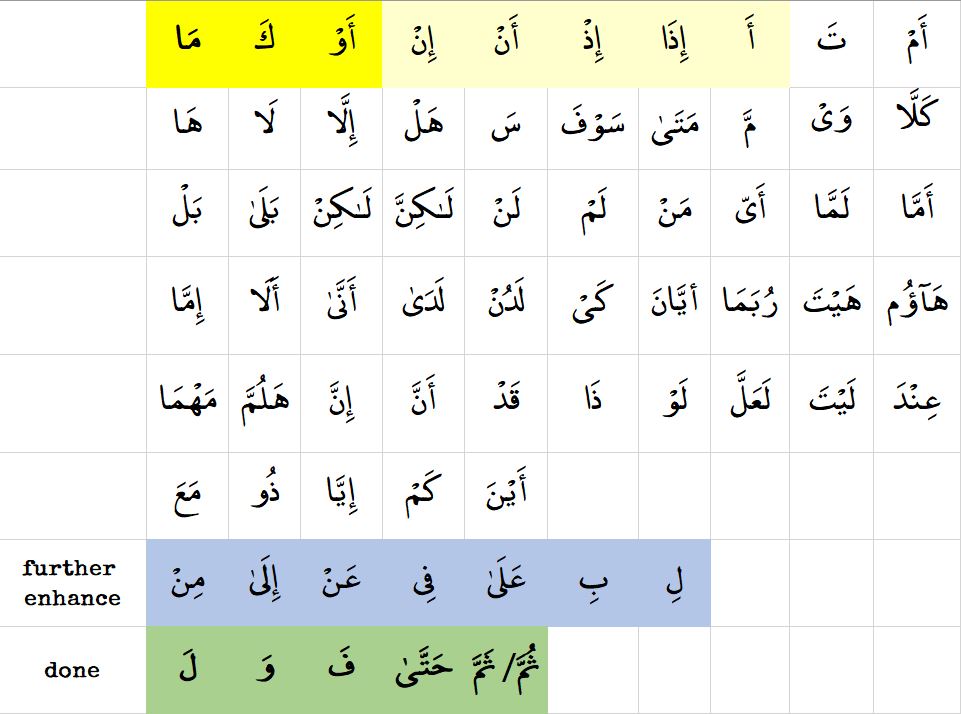
Below picture gives status for Arabic Particles Notes as on 18th April 2020:
Arabic Particles Notes Project


2. Learn Arabic Verb Forms
Time Consumption = High,
Status = 13 posts and completed!
Importance and requirement of in depth posts = Very High:
Arabic verb Forms I to XI and BQI , QI, QIV 
See Arabic Verb Forms for published notes.

3. Learn Core Meaning Shades of Important Arabic Words
Time Consumption = Normal
Status = 13 posts!
Importance of posts focusing on core meaning shades of word instead of mixing relevant and less relevant meaning shades = High  
Arabic Vocabulary Posts on words used in The Qur'an that are very important. (About 300+ posts targeted) .
See Arabic Words Core Meanings for notes so far published. 
Next 4 targets are فُؤَاد قَلْب أمْر شَآءَ but due to the amount of time required to investigate multiple books in detail and to do research to investigate the core meaning shades and then also put the derived meaning shades to the test using The Qur'an for contextual analysis, these posts are paused for now. As you saw in my Arabic Words notes published so far, I attempt to research multiple books, searching for the core meanings, then I put the derived meanings to the Test using The Qur'an. This analysis using Qur'anic Usage is the most important step for any researcher. I don't take the easy route of simply adding up all the available notes in all the dictionaries, rather I focus on trying to extract the core meanings and also try to verify them using The Qur'anic context.

4. Islamic Projects
Time Consumption = High
Status = The most important project, The Qur'an Concordance project is complete MashaALLAH!
Importance = Very High

Sponsorship.
Sponsor my time spent for this blog i.e. pay per hour to get more posts generated. This payment can be in return for advertisement on this blog or just for the sake of service for Islam.
Note: Sponsors can decide which Arabic Particle, Arabic Verbal Form or Arabic Word to post next, but The Qur'an will be 1st priority and until all Qur'anic Vocabulary is completed, other words will not be processed. 

Suggested Project requiring sponsorship now to initiate and proceed quickly on it inshaALLAH!
Grammatical Concordance of The Qur'an
in which all Aayaat containing a grammatical concept are gathered together & all grammatical concepts used in The Qur'an have an entry
Labeling each Ayah for used Grammatical concepts requires full-time time

Suggested Posts Series requiring sponsorship now to speed up progress :
Arabic Particles and Related Words Meanings
 

Advertise. 

Advertise your halaal business or institute etc. on this blog via suitable banner or text advertisement on the right side bar.

Why?

1. Ideally, I want to spend about 50 hours per week on the blog and its related services. But that is not possible without shifting full-time to the blog. I can't achieve this part-time as a hobby, since the areas I am focusing on are unique and require due time. Hoping that this can be achieved in parallel with spending most of the productive hours doing worldly work for making a living to meet family and financial responsibilities is nothing more than wishful thinking. But, I am rest assured that whatever happens, I am only accountable for what I can achieve using the resources (including time) I have, not for what I could have achieved if something that is not in my control (e.g. sponsorship) also happened. 

2. Other alternatives are selling the knowledge via books, ebooks or offering paid teaching. I don't want to do any of these as my services for Islam are free for all, whether they can afford or not, whether I can generate many posts or no posts, and I recommend sponsorship only from the ones who can afford and who may also want to benefit by advertising in return.

3. Teaching in return for expensive tuition fees is being done by some, selling books on Islam is being done by some, but in my opinion sponsored free for all services is the best option, i.e. win win for all.

Offers from Institutes and Organizations for joining them

Organizations and Institutes are welcome to contact me if they want me to work with them, but I won't join or be linked to any organization or institute unless it fulfills my following 2 requirements:

1. All Islamic Work Produced is to be free for all to access in all formats. They can cover costs via sponsorship, funding, donations etc. as long as they don't restrict free access to Islamic Material in any way.

2. No blind acceptance of any institute or organization's views or beliefs. Each view is to be evaluated based on evidence and merit. I am willing to work with them on matters of public benefit as long as they don't demand me to have same view as them. We should work together for mass benefit of Islam and Muslims, setting our differences aside for later or ignoring our differences.

Any genuine reasons for not supporting these Projects, Tools & Posts?

Those who think that I am not the person who should attempt all these projects, tools and posts, you should at least do 1 of the following:

1. Ask your favorite scholar / institute / organization to launch all these projects, tools and posts and make all the end products free for all. (They may use funding/ sponsorship/ donations)

2. Launch these projects, tools and posts yourself. (You may use funding/ sponsorship/ donations)

If you do any of the above 2, then I have no problem at all, if you don't support any of my projects, and am even ready to guide you further on how to initiate these.

These projects, tools and posts are very important. The problems being faced by Muslims are too diverse and complex and there is no single solution. Multiple, parallel efforts are required to solve these and proper research and spread are very important to make knowledge available and accessible to all and in the required depth. Spreading the understanding of Classical Arabic is one of the key steps in this regard.

Suggested Rule of Implementing Metered & Transparent Funding & Utilization of Islamic Services for Islamic Projects :

Based on https://rse-i.blogspot.com/p/islamic-ideas-list.html 
No hidden or ambiguous utilization of donations, funds, sponsorship money or campaign money etc. - Transparent tracking of:
  • Exact work done.
  • Exact time spent.
  • Exact person who worked on the task.
  • Exact amount of money paid to the person for the above 3.
All my projects will follow this rule inshaALLAH!   

Sponsored Full Time Islamic Workers Concept

Copied from : https://revivearabic.blogspot.com/2016/04/sponsored-full-time-islamic-workers.html

A necessary requirement for Proper & Fast Islamic Research & Spread in today's complex & confusing time. 
Concept only, no actual working done so far. 

Suggested Rules & Summary:

1. Highly Skilled Paid Manpower spending about 50 hours/week/person. 1 person = 50 hours/week, 10 persons = 500 hours/week. Doing Unbiased Research. Truth is good enough, just do proper unbiased & thorough research with honesty and dedication, spending as much time as is required for properly exploring a topic and studying as many reference books as required in that area.
2. Sponsors Funding the Payment for Highly Skilled Manpower, in return getting advertisements to their Islamic Site, Islamic Organization, Halaal Business, Islamic Books etc.
3. Organizers, managing everything transparently. How much money is given by which Sponsor to which Full Time Islamic Worker for which project for how many hours work.
4. Volunteers, Providing free Islamic Worker services for 5 to 10 hours per week.

Analysis: 
Today’s busy life schedule makes it difficult to spend time on job and Islamic work together. For example, If a person does job of 8 am to 7 pm with travel included for 5 days. It takes out 55 hours from the week. Such a person with family responsibilities, if he tries very hard, can manage about 10 to 14 hours per week for Islamic work. If such a person can be dedicated for Islamic work and spends 50 hours or more per week on Islamic work, that can help him achieve about 5 years work in 1 year. A project can be launched which gathers a team of high potential Islamic workers and good Islamic sponsors :

1. Full Time Islamic Workers - The Work Force :
The Islamic Workers can be selected based on their past volunteer projects, Islamic contributions and skills. These can apply by sharing their skills, examples of their past work, interests etc. Other people who have worked with them in the past on Islamic projects can provide recommendation with brief comments on their performance. Then based on donations or sponsorships available for a project, they can be selected as full time paid workers for a period of 6 months to 1 year on some projects. At least 6 months period is recommended since this person will have to leave his job and become a full time Islamic worker and donations should also be at a suitable level to encourage him to leave his job and join as full time worker. A site can be set up where such potential persons will update monthly a kind of CV or profile and their areas of interest in priority from set of projects decided and listed. These are planned to be the man power or workforce.

2. Donors & Sponsors - The Funding:

The donor Muslims can make donations to support the selected high potential people as full time paid Islamic workers. They can select the projects in which they want to contribute and how much and how regularly. The sponsors are those donors who want advertisement to their halaal business, institute or their own Islamic site in return for sponsoring. These are planned to be the sponsors/financiers of the project.

3. Volunteers :
The volunteers can be those who will provide their free services in limited time i.e. about 5 to 10 hours average per week (average i.e. overall this rate should be maintained, if 1 week he can only manege 6 hours, he can do 12 hours in next 2 weeks to cover this up or 11 hours in next 4 weeks etc. and maintain average of 10 hours per week) . They will be assigned the most in demand task and these can start working immediately. Most in demand potential is classical Arabic to English Translation.

4. Organizers:
Organizers should be trusted Muslims who transparently manage donations and their distribution to paid Islamic workers. This project should be very transparent, how much donation is being given to which person for which task, and that task if possible should also be uploaded as draft version somewhere or at least shared with donors to that project, so that they can continue seeing the progress of their interest work. Moreover, donations should also be tracked in a separate sheet, where the amount of donation by a donor used for a project should also be marked and this sheet can be regularly shared with the donors.

5. Potential Areas:

Many potential areas are there e.g.

1. Classical Arabic to English Translation e.g. translation of selected roots from Taaj ul Uroos or Lisaan ul Arab for roots used in The Qur’an starting from last 8 Arabic letters. Translation of The Qur'an with a lot of dedicated time, effort, and skills.This is the most in demand skill and potential!

2. Islamic Research and Sharing of that research in unique areas of interest e.g. Research into Qur’anic Studies selected areas, Sunnah issues.

3. Quick Study Tools development, enhancement and launch
 e.g. comprehensive quick study tool which searches an Arabic root in all major classical Arabic Dictionaries and shows all the relevant content on searching together. A comprehensive Tafsir tool that shows all available useful Tafaaseer on any Ayat together. Qur'an Quick Study tools and other important books quick study tools. Due to shortage of time, make study instant and quick by making quick study tools, so that interested people who want to study some area of Islam, can do so immediately. No matter how much time they have, they can study directly and quickly using quick study tools instead of 1st finding the topic and then studying.

4. Searchable text projects: Conversion of important scanned books to fully searchable books and applications by typing them again in proper formatting.

5. Islamic services: like preparing blogs on an Islamic field e.g. Qur'anic studies, Arabic learning, personal teaching, web designing, and many other areas can be identified.

But the need today is to quicken the Islamic Research and Spread it far and wide. 

Youtube Clip from Siraj Wahhaj’s lecture  :
We Need Full-time Workers For Islam

Interested people can email me at aasimiqbaal @ gmail.com to discuss or give suggestions on how to improve the concept further and once fully refined, a version can be prepared which can be shared with popular sites and scholars and launched.

Example: Lane was identified as having high potential and hired as full time paid worker on preparing an Arabic English Lexicon. He was able to focus his energies and time on this project without having to spend time on doing a job and instead of doing this as a hobby or part time volunteer activity, he worked on it in a focused manner and was able to provide due time to it. We should have potential Islamic translators having skill level equal to or higher than Lane. Once the project is launched from a proper platform, the energies of such high potential Muslims can be focused on important Islamic projects instead of being spent on worldly jobs.

Interested workers and donors can email, so that I can add reference to their services on this post, so that they can be contacted by the person who launches the project, whenever the project is launched. The potential workers to prove their skills and potential will have to do some volunteer work of about 10 hours in the most in demand project matching their skills as indicated by the organizer who launches the project, based on which their quality, skill, speed etc. can be evaluated. The potential donors and sponsors should indicate their way of earning to organizer so that only those donors are selected who don’t have any disallowed money (e.g. ribaa) in the earnings.

Interested volunteers can also email me. Currently most in demand project is Classical Arabic to English Translation. Also volunteers can be assigned various smaller tasks from above 5 potential areas. The high potential volunteers who show excellent performance, are most suitable candidates to be chosen as paid Islamic workers in addition to getting my recommendation. The volunteer activities can start immediately by coordinating with me, but think over it before applying, as sometimes I receive a volunteer mail and when I assign him or her a task, the task is not submitted. In volunteer activities I don't want to make any kind of push as this is volunteer activity by its very definition, I can assign target timelines for paid workers and push them with due respect to meet the targets, but not volunteers. Before posting here your interest to volunteer, also note that it is not certain when the paid project will start, and if you can easily manage without harming your current job, then I will recommend you participate. This project may even be limited to volunteer based project for a considerable time till it gains acceptance among high impact Muslims and ALLAH Knows when that can happen, so volunteers should be prepared and willing to continue this as volunteer based project.

How Mega Free for All Educational Resources founded by Non-Muslims are using the Funded Free for All model

Archive and Wikipedia both collect funding to keep their mega sites free for all.

Archive 2018 fundraising campaign to collect 6 million dollars (screenshot taken on 25th December 2018)


Wikipedia 2016-2017 fundraising, for details see their 2016-2017 detailed report

On smaller scale projects, even authors are using funding model to generate free for all books , e.g., see this JavaScript book, for which, only to make a 3rd edition of its existing book, the author collected all this funding. Why give the lion's share to the publishers when it is mainly by the authors for the readers.

Also read Free for All Islamic Books in PDF and other formats

Research, investigate and be bold and courageous enough to speak : truth / reality / fact : openly and clearly, even if you are alone in your stance, even if the whole world criticizes you, without resorting to any cover-up, hiding any inconvenient or hard truth, sugar coating facts, use of diplomacy, trickery or foxery for gaining more following and for appearing more compliant to what masses like.
Constitution

Poetry by Iqbal: Translation Attempt:
Constitution of youthful-men: speaking : truth/ reality/ fact : and dauntlessness
ALLAH's lions don't know foxery